
Content Writing vs. Copywriting: What’s the Difference?
Every piece of content on your website, social media, or email campaign serves a unique purpose, from building brand awareness and fostering trust with potential customers, to making sales and filling your schedule with booked consultations. But not all content is created in the same way or with the same intentions. Content writing and copywriting have different goals, audiences, and writing styles.
What is Content Writing?
Content writers craft text to inform or educate a specific audience. This type of content is often found in long-form pieces like blog posts, which are typically offered for free. The goal is to engage readers — usually customers or potential customers — and build trust in the brand without pressuring the audience to take immediate action.
Why Do You Need a Content Writing Strategy?
A content writing strategy builds trust with your audience and showcases your brand as a credible and reliable source.
An excellent content writing strategy focuses on delivering high-quality content that educates and engages, offering insights, inspiration, and information.
To be effective, your content strategy will take time, research, and good writing. It may guide someone into creating something, purchasing a product, or trying a new hobby.
While a conversion is always welcome, it is not a content writer’s primary goal. But a good content strategy makes it easier for good copywriting to convert readers into customers.
What is Copywriting?
Copywriting focuses on crafting short, compelling content that prompts immediate action from the reader. This type of writing can be found in marketing materials and promotional efforts, where the goal is to persuade the audience to purchase a product or service or take a specific step toward engagement.
Why Do You Need Copywriting?
Copywriting is essential for any business looking to prompt immediate action from its audience. While it can inform, its primary purpose is to persuade — convincing someone to buy your product, sign up for your newsletter, or follow through on another direct call to action.
Copywriting supports your sales efforts and makes it easy to see how effective your messages are in driving specific outcomes.

Key Differences in Content Writing vs. Copywriting
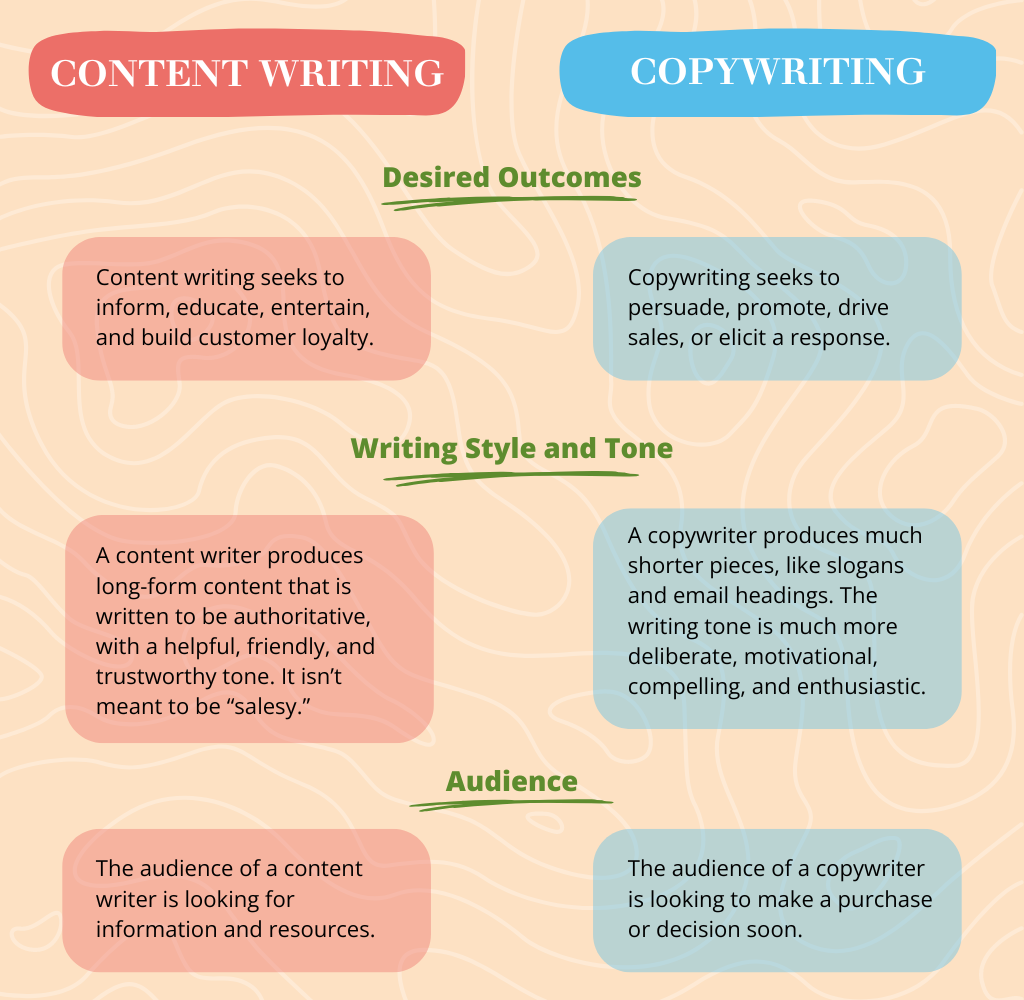
The main differences between content writing and copywriting can be broken down into three categories: desired outcome, writing style and tone, and audience.
Content Writing Strategies
Certain approaches are necessary for effective content writing. Here are some things you must have or address to do this type of writing well.
Understand Your Audience
To be a successful content writer, you must know your audience deeply. Dive into their interests and concerns through audience research and learn what they want, need, and what questions they have. Then, you can decide what content will be helpful for them and how to craft it.
This information will allow you to create content that catches their attention and builds trust, showing you’re a reliable source to which they can continue to turn. Keep your content closely aligned with what they’re looking for, and you’ll see your engagement grow.
Use SEO
A critical difference between content writers and copywriters is the focus on search engine optimization (SEO). SEO helps people find your content when searching for information about a topic, product, or service.
While smart keyword research and the strategic use of these keywords are essential parts of your content writing SEO strategy, the best plans go beyond fitting the keywords into the article like a crossword puzzle.
A content writing strategy also strategically uses meta tags to help communicate with the web crawlers who determine what shows up on your search results. SEO also involves keeping an eye on analytics to monitor your content’s performance, ensuring it ranks well on search engine results pages.
Headlines and Visuals
Engaging headlines and visuals are crucial in content strategy. They guide readers through the article and clarify information. Beyond the text, including brand colors, photos, and symbols makes your content more visually appealing and builds awareness and reputation with your audience.
Tell a Story and Build Trust
Storytelling in your content can deepen the connection with your audience and build trust. Everyone enjoys a compelling story. It humanizes your brand, makes your information relatable, and encourages sharing.
Quality Over Quantity
Simply flooding your website with AI-generated articles will not take you far. An effective content strategy includes well-researched and informative articles written in a straightforward, engaging way.
Rushing to publish unhelpful content can actually work against you! You risk damaging your reputation and undermining any trust you have built with your audience.
Copywriting Strategies
Different specific approaches are necessary for effective copywriting. Here are some things you must consider and implement to do this type of writing well.
Understand the Psychology of Persuasion
At the core of copywriting is the art of persuasion, deeply rooted in psychology. Skilled copywriters know how to use emotional hooks like fear, trust, and happiness to connect with their audience.
Copywriters have a toolbox of strategies that allow them to tune into this psychology of persuasion to convince potential customers of the value their product or service brings to their lives.
Using techniques like creating urgency and leveraging the fear of missing out (FOMO), copywriters prompt action with phrases like “Limited time offer!” or “Act now!”
Know Your Audience
As with content strategy, you also must know the audience you are communicating with in your copywriting strategy. Because the goal is to persuade rather than inform, copywriters must understand this audience’s goals, challenges, and objections. They anticipate and address these objections proactively to drive action. By truly understanding your audience, you can tailor your message effectively, driving engagement and conversion.
Highlight Benefits and Features
Copywriting concisely emphasizes a product or service’s benefits and features. It clearly articulates how your offering addresses your audience’s wants and needs. A copywriter focuses on the value proposition to capture an audience’s attention and persuade them to take the next step.
Research Competition
An excellent copywriting strategy also involves researching the competition. Copywriters analyze their messaging, positioning, and tactics to identify gaps and opportunities and use that information to differentiate their own products and services. This work develops a strategic awareness that can position your product or service more effectively.
Build Trust with Testimonials and Reviews
Copywriting strategies also involve leveraging testimonials and reviews to establish credibility and trust with your audience. It can allow you to highlight specific benefits and demonstrate real-world results to help alleviate any doubts or concerns. This social proof reinforces your brand’s reputation as a reliable and trustworthy choice in the market.
Include a Call to Action
In copywriting, a clear and compelling call to action (CTA) is essential for guiding your audience towards the desired action. Whether it’s making a purchase, signing up for a newsletter, or scheduling a consultation, the CTA should be specific and actionable. Use persuasive language to prompt immediate response, such as “Shop Now,” “Subscribe Today,” or “Book Your Appointment.”
When to Use Content Writing
Now that you’ve started developing your content writing strategy, where will you apply it? You’ll want to think strategically about content writing anywhere your main goal is to inform and engage with your audience. Here are some of the most common options:
- Blog posts
- Social media posts
- Newsletters
- Articles
- E-books
When to Use Copywriting
Copywriting is everywhere! Copywriting strategies come into play whenever you ask someone to take immediate action. For example:
- Advertising copy
- Sales pages
- Email marketing campaigns
- Landing pages
- Video scripts
Let Content Journey Take On Your Content
Content writing and copywriting have many similarities but different goals and strategies. To be successful, you can’t have one without the other. You need to build trust and awareness with your target audience through content writing, but you will eventually want them to take action — that’s where copywriting will come in.
Content marketing is a lot of work. From strategy to implementation, it can take up a significant amount of time and be a lot for someone to take on while they try to run their business. Content Journey can provide everything from strategy to content creation. Book a call today, and let’s discuss how we can grow your online presence while you focus on your business’s day-to-day.